MG (letters connected) mark

A number of glass factories operated in the Los Angeles area during the early 20th century, including Southern Glass Company, California Glass Works, Long Beach Glass Company, Latchford Glass Company and McLaughlin Glass Company.
Maywood Glass Company was organized in 1929 by Benjamin H. Koons (formerly a mold shop supervisor at the Southern Glass Company at Vernon) but the factory was likely not actually in operation and producing glass until sometime in 1930. Koons served as president, James Moore acted as vice president, G. R. Helsing was secretary, and S. H. Templeton was treasurer for the newly created glass company.
Maywood was located in Compton, California, which is basically part of the city of Los Angeles proper, and in fact is one of the oldest parts of the metropolitan area, the city of Compton having been officially incorporated in May of 1888.
According to the information on Maywood Glass in Julian Toulouse’s reference book (Bottle Makers & their Marks, published in 1971) there were three different variations of the MG mark used by Maywood. In two of the variations, the letters are touching – and in those cases the mark might be described as a “monogram” or “insignia”.
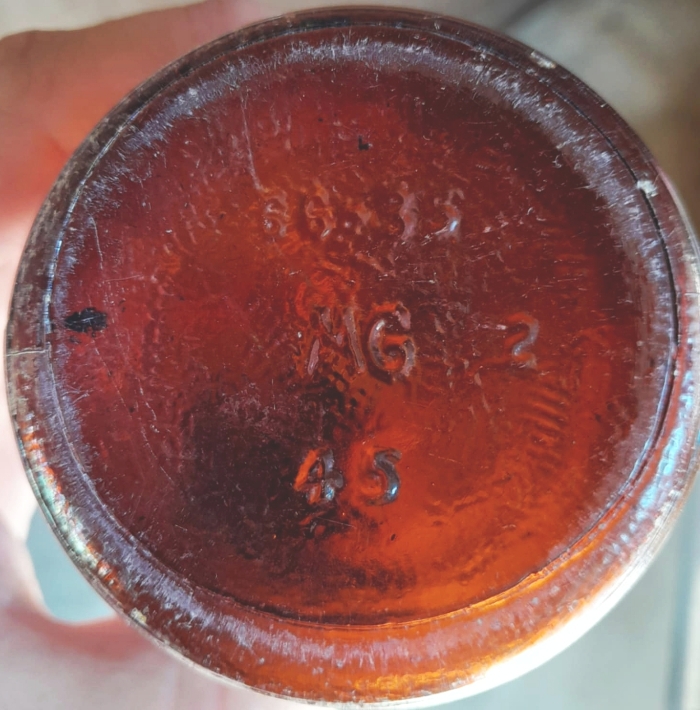
Maywood Glass did use at least two slightly different marks during its existence, judging from the empirical evidence found to date.
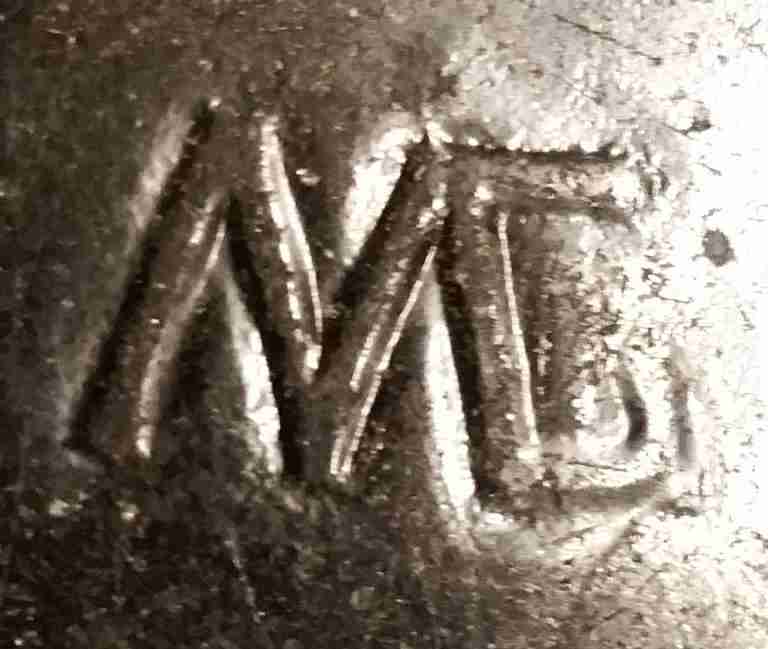
One mark, with the letters not connected, was shown as “Type 1” on page 357 of Toulouse’s book mentioned above. Toulouse attributes that mark as “Circa 1930”. Exactly how he came to that date range conclusion is unknown. I have only seen one example of that particular variation, and that only recently (see photo of base mark supplied by Ethan Montgomery in August of 2025, below). The letters are relatively “vertical” and although placed quite close to each other (closer together than as drawn in Toulouse’s book), they are NOT connected. The bottle bears a “2” to the right of the mark which might be a date code for 1942.
“MG connected” mark
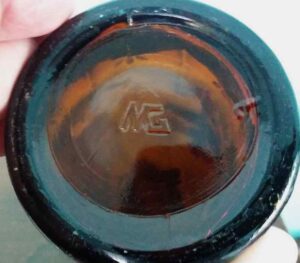
The second known mark might be termed “MG-connected”. The “MG” has, more or less, been combined to create one monogram or character. The right vertical stroke of “M” is the same stroke as the far left stroke of “G”. This is the mark seen on the great, great majority of Maywood-produced bottles. This mark is termed “MG- ligature” by Bill Lockhart in the Bottle Research Group article about Maywood Glass Company and their bottles (linked below). Typically, the “M” is oriented as normal, or slightly right-leaning, and the “G” is leaning BACKWARD (toward the left). There can be some very slight variations of the appearance of this mark from one bottle to another but I have not made any such distinctions on this page.
ADVERTISEMENT
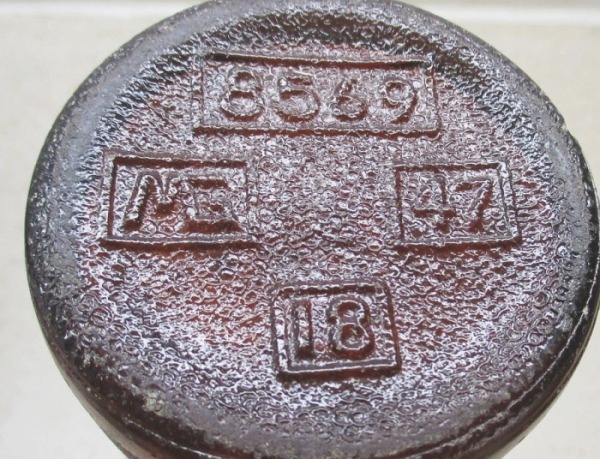
This second known variant (listed as Type 3 on Toulouse’s entry noted above – on page 357 of BM&TM), evidently actually dates at least as early as the mid 1940s, and probably much earlier, perhaps from around the time the company began operation, although no one really knows for sure. In his entry on the mark, Toulouse wrote that this variation was “circa 1958” which cannot be accurate, as bottles with 1940s date codes are confirmed. (However, many kinds of bottles made by Maywood do NOT carry date codes – so they can be hard to date exactly. Although returnable beverage bottles – for beer and soda – usually bear date codes).
Toulouse also pictured another mark variation (he pictured it as Type 2 – “circa 1940” – also shown on page 357) with both letters touching and leaning forward (leaning to the right). I am not aware this variant has been confirmed. If you have seen this on a bottle, please let us know!
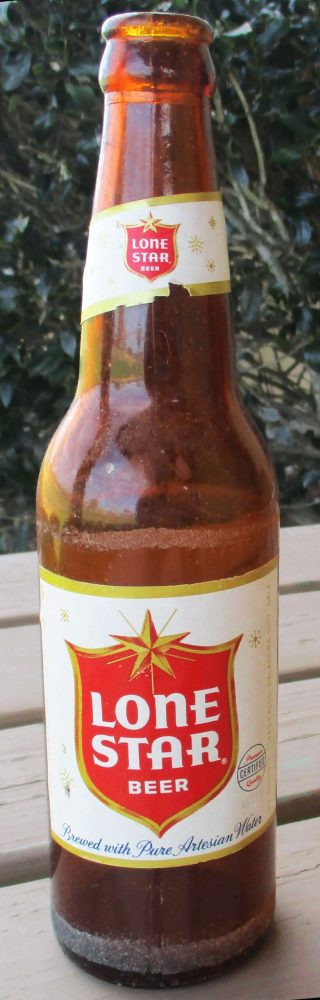
Recently, I received (from Don Nored) photos of a Lone Star Beer bottle (shown on this page) which is marked with the MG-connected logo on the base, along with a date code for 1947.
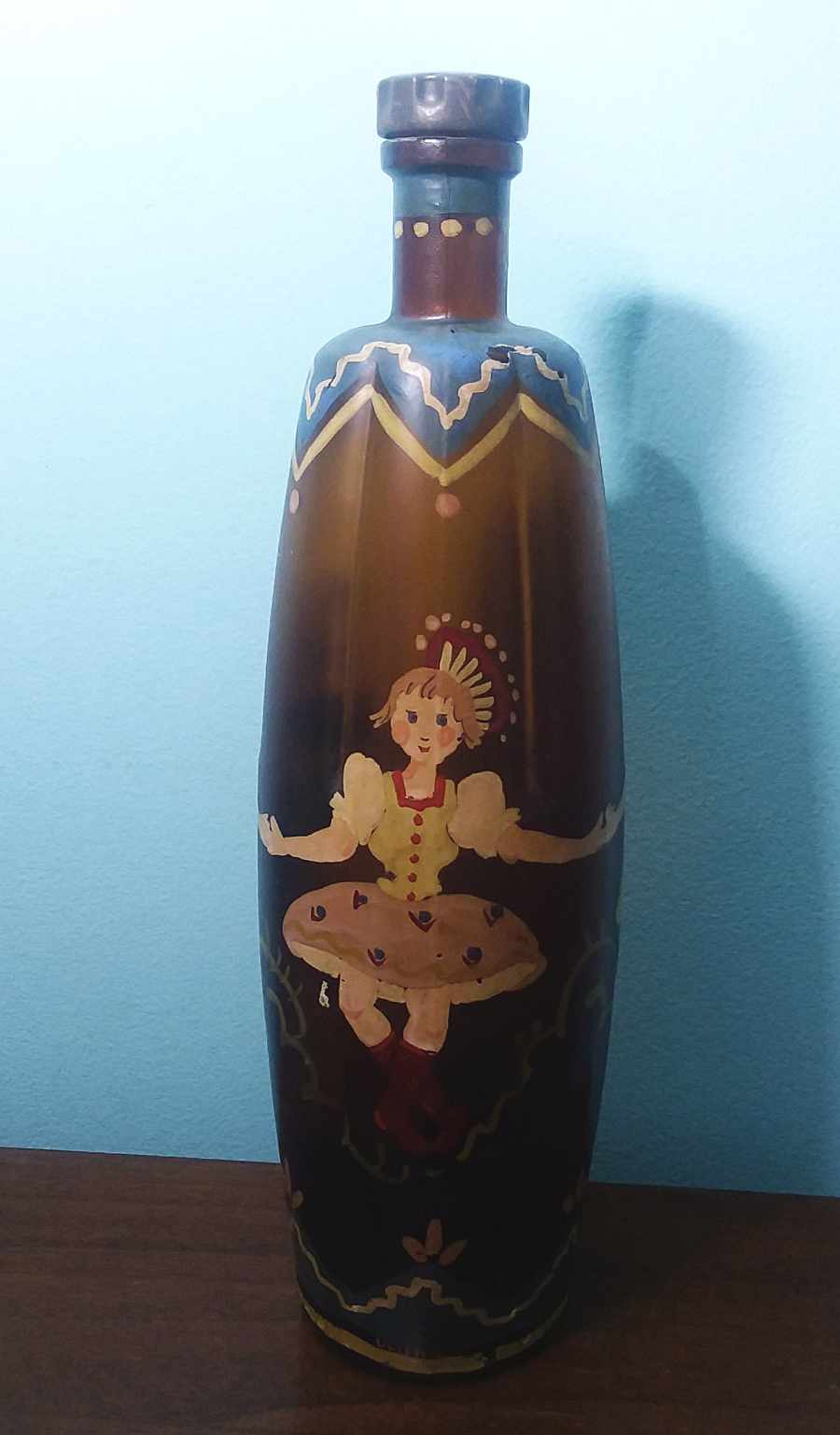
Maywood Glass made a variety of utilitarian containers including soda bottles, bleach and chemical bottles, beer bottles, food bottles, syrup and vinegar jugs, whiskey flasks and other typical bottles of that time period.
Probably most of the containers made by Maywood were sold/distributed in California and throughout the Western states of the US, and are more commonly found in those areas. Maywood Glass Company was purchased by Anchor Hocking Glass Corporation in 1959. From 1959 to 1961 the Maywood Glass Company served as a subsidiary of Anchor Hocking, retaining its own identity, but then came under complete control of AH in 1961.
Note: it is likely that some of the bottle molds in use at the time of the purchase of the Maywood factory by Anchor Hocking in 1959 were not re-tooled with the new Anchor Hocking trademark (letter “H” superimposed over an anchor symbol) until sometime in 1961, so beverage bottles might be found with a “60” or “61” date code on them along with Maywood’s MG-connected mark.
For more information on Maywood, check out this in-depth article by Bill Lockhart & the Bottle Research Group: Maywood Glass Company
ADVERTISEMENT
For an extensive list of glass manufacturers’ marks seen on bottles, fruit jars, electrical insulators and tableware, please see the alphabetical listings on the Glass Bottle Marks pages, starting here with Page One.
Please check out my website Home Page.
I have a Diamond Head Beverages 7 oz. soda bottle made by the Maywood Glass Co. in 1960. Your website says that the company was bought out in 1959 but makes no mention of the mark being used afterward. I presume this is from the transitional period before they switched out all of the marks. Many local soda bottles were made by MG Co. so I would be happy to send you some photos of other marks.
I am going to be selling it so that is why the pictures have two sodas instead of one. The left one is the MG Co. specimen. The other is made in Japan which is really cool. I have not been able to decode the mark (TK in an oval). I also collect a lot of early Japanese bottles (Pre-WW2) so if you’re looking for something new to research, my Japanese bottle marks are ready to be solved.
Hello Hezekiah,
I sent you a reply through direct email, but have received no response. You might need to double-check your spam folder, as sometimes my emails are re-directed to recipients’ spam or junk folders. Your post spurred me to make a slight edit in the text of this article on Maywood Glass.
Although Anchor Hocking purchased Maywood Glass Company in 1959, at first the factory was considered a subsidiary of Anchor Hocking and retained their own identity for a short time – evidently until 1961. In that year Anchor Hocking took complete control of the factory and it became part of that corporation. I am assuming (but don’t know this to be 100% correct) that some molds in use in the 1959-1961 period were not re-tooled immediately to reflect ownership by Anchor Hocking.
So, bottles with 1960 or 1961 date codes might be found, but also bearing the “old” MG-connected mark. Eventually, presumably by 1961 or 1962, all the molds already in use would have been re-tooled (re-engraved – replacing the MG-connected mark) with the “H superimposed over an anchor symbol” which was the trademark used by Anchor Hocking.
Thanks for your post!
David
Hi, sorry for the late reply. I did receive your email but it was buried by a whole bunch of other emails. I will get back to you via gmail as soon as possible. I have to prepare some photos for you. Thanks for the info.
I have a one gallon amber jug with markings on the bottom “MG (connected but not square), Patent No 107541 – 107542 around the circle of the base and an “A” and what looks like an “x” in the middle of the bottle. I would be very interested to know its history like what it was used for and when. Thank you!
Hi Anita,
That patent design for a bottle was issued on December 21, 1937 and was assigned to Maywood Glass Company. So presumably your jug was made sometime within a few years of that patent being issued. The drawing of the design appears to be a typical jug used often for such products as vinegar and apple cider.
Here is .PDF file linked to the Google Patents page showing the patent registration info:
Patent #107,542 – Patented Dec. 21, 1937 – Google Patents
Hope this helps!
David>
I have this exact jug except mine is heavily embossed with grape vines and grapes. On one side is a flat area approx. 4 1/2 X 6 1/2 , where I assume a paper label would have been affixed. I found the jug in the basement of an old farm we purchased in ’71. The house had no running water, heated with coal, and had supposedly been vacant for 10 yrs. prior. Is it possible due to the grape embossing these bottles were also used for wine? Do you have any history on that??
Thank you !
Hi Louise,
Yes, I think it is likely your jug originally contained a brand of wine (or, in a few cases, possibly grape juice). I did a keyword search on the Worthpoint.com site (that includes a large database of past online auction listings) and found lots of clear glass jugs with grape designs on them. They were made by several glass manufacturers over the years.
You might try browsing these and see if any look like your jug. (Note that the results include some irrelevant listings and some misinformation in item descriptions).
Worthpoint keyword search for vintage clear glass jug with grapes design
Hope this helps!
David
So my family came from the east coast, after first arriving from Italy in the late 40s early 50s. My grandfather, his 6 brothers all started at Maywood Glass. My dad used to work there as a teenager when he was out of school, as well as all his brothers. I still have a couple uncle’s and cousins who still work for Anchor Hocking (although owned now by some European conglomerate)…… My family has a rich history at Maywood Glass and we have many pictures and there were even news articles about the Italian Quinto Brothers all at MG.
I can usually provide any information if you would like. My father is still living in his 70s and talks about it often.
Caleb Quinto
Caleb I know your Uncles. Vince worked production Hot End, Donny worked Mould Shop, one Uncle worked shift Supervisor Hot End. Cousin worked Hot End, and Upkeep. That Cousin later worked Tank Manager, Ball Glass. Any Word on Donny. Sincerely Dave
I recently dug up a clear bottle 4/5 quart with the MG logo. The MG is connected and the G is squared. The marks are as follows:
1725-B
MG44
12
Would you know anything about this bottle?
Thank you.
i have a clear bottle MG connected with 4/5 quart. The bottom of the glass numbers relate 7112 within a square and also the number 26 in a square. Would this identify as 1926? It has a greenish tint. May have been liquor bottle. No doubt Maywood Glass.
Hi Victoria,
The 7112 would be a mold style number assigned to that particular bottle design. I’m not sure what the “26” means but it certainly doesn’t stand for 1926 because Maywood didn’t start operations until about 4 years later.
Best regards,
David