Collectors sometimes run across so-called “Crackle Glass Insulators”. They appear fairly often on online auction sites, at garage and yard sales, thrift stores, antique malls and flea markets.
The story may be told that these are examples of insulators that were hit by lightning while installed on the electric lines. In practically all cases, this story is not true. (If an insulator was actually struck by lightning, the result could range from random cracking, to complete destruction of the insulator, but not an even, crackled effect over the entire surface of the glass. Occasionally, what appears to be “tracks”, like the trail of a tear drop with a slightly roughened surface extending downward along the outside of the insulator is seen, and this “flash burn” effect is attributed to a lightning strike occurring nearby).
In the late 1960s and early 1970s, during the early years when interest in insulator collecting was first gaining steam, some people began “crackling” insulators, usually as a sort of “fad”— a fun “art” or “craft” project. Recipes for the process were actually published in at least one major insulator-collecting book of that era. Some crackled insulators have been altered even in recent years (by unscrupulous online sellers), though probably most of those found today were crackled in the late 1960s and the 1970s.
ADVERTISEMENT
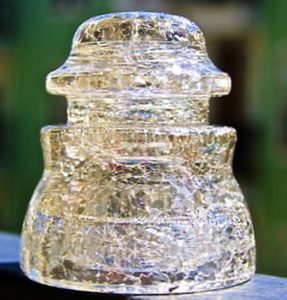
Nowadays, the process of crackling insulators is seen in a negative light by most “serious” insulator collectors, who consider the resulting insulators to be damaged or destroyed pieces with very little, if any value (other than mere decorative value as an “accessory”, knick-knack, conversation piece or “shelf sitter”).
Insulator collectors, for the most part, tend to be interested in the actual history BEHIND a particular piece, including factory origin and associated markings (glass company or utility name, city, state, patent dates, etc), it’s age, type, color, etc. And the collectible value of any glass insulator is strongly impacted by it’s condition.
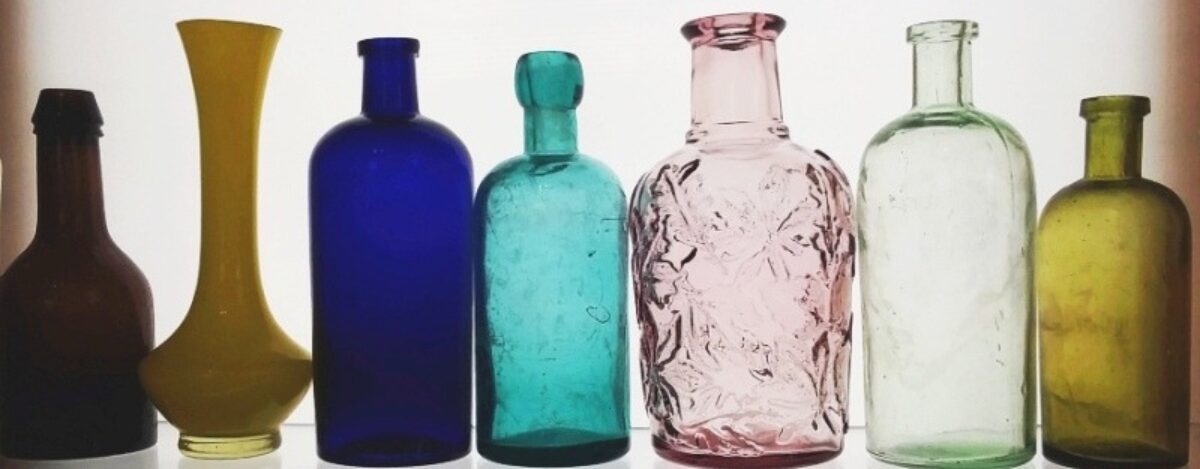
The “Crackle Glass” insulators were intended to imitate the appearance of true Crackle Glass which is a type of glass produced by a number of art glass companies, especially during the 1940s-1970s, such as the Rainbow Glass Company, of Huntington, West Virginia, Bischoff Glass Company, Viking Glass, Blenko Glass and others.
Many kinds of articles were made in crackle glass including vases, bowls, pitchers, compotes, etc. A very wide range of bright, rich colors were produced. Most of the items were handmade by professional craftsmen. The glass item was formed and then quickly chilled (by plunging into cold water) to create a fine interconnecting network of lines/cracks – usually on just the surface, or extending throughout most of the glass. The piece was then reheated (to the point of melting) to seal the glass surface so the piece would be more structurally sound thus less prone to breakage.
However, this re-sealing process was not usually true of the crackle glass insulators. Most of those were not re-heated after crackling, so are much more easily broken. The cracking usually extends completely throughout the entire insulator and often the glass is unstable and prone to falling apart.
Luckily, the great majority of crackled insulators are found to be the most common, plentiful types, such as the Hemingray-17, Hemingray-42 (see Hemingray Glass Company), Hemingray-45, Whitall Tatum Co. No. 1, Armstrong DP 1, and others of that genre, and those types were made by the millions for open-wire electrical communication lines. Since so many of them were being removed from telephone and telegraph lines during the 1960s and 1970s, it was not generally considered “bad” or “wrong” to alter such common insulators for the purpose of creating a craft project of this type. Probably most crackled insulators are of clear or aqua glass, but sometimes the surface of the glass was artificially colored or stained in odd colors (strong pink, purple, red, yellow, orange, etc) creating the illusion of a more unusual or valuable piece.
However, it is known within the insulator collecting hobby that at least a few extremely valuable, scarce to rare insulator types occasionally met the fate of being crackled, no doubt by someone who had no knowledge of insulator types, values, history or relative scarcity. Such a fate could have reduced a thousand-dollar insulator (or even one of much higher value) to only a very small fraction of the original value it would have had as an undamaged example to collectors.
ADVERTISEMENT
I hope this webpage will help clear up some of the confusion on these insulators!
Please check out this page for general information on insulators: General Overview / Summary about Glass Insulators.
For a list of glass factories that are known to have made insulators, with brief info on some of them, please click here: Glass Insulator Manufacturers .
Please click here to go to my website HOME page.
ADVERTISEMENT
I have 2 glass insulators with the name Maydwell, do you have information for this manufacture? one has a number 10 after the name with sharp drip points. the other has a number 42 with round drip points. Thank you for your help. Donna
Hi Donna,
The information is on my webpage here: Glass Insulator Manufacturers. Please see my entry under “Crystallite Products Corporation”.
~David