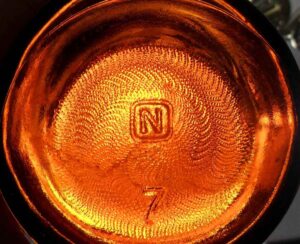
“N in a square” or “Boxed N” trademark as seen on glass bottles, jars and jugs
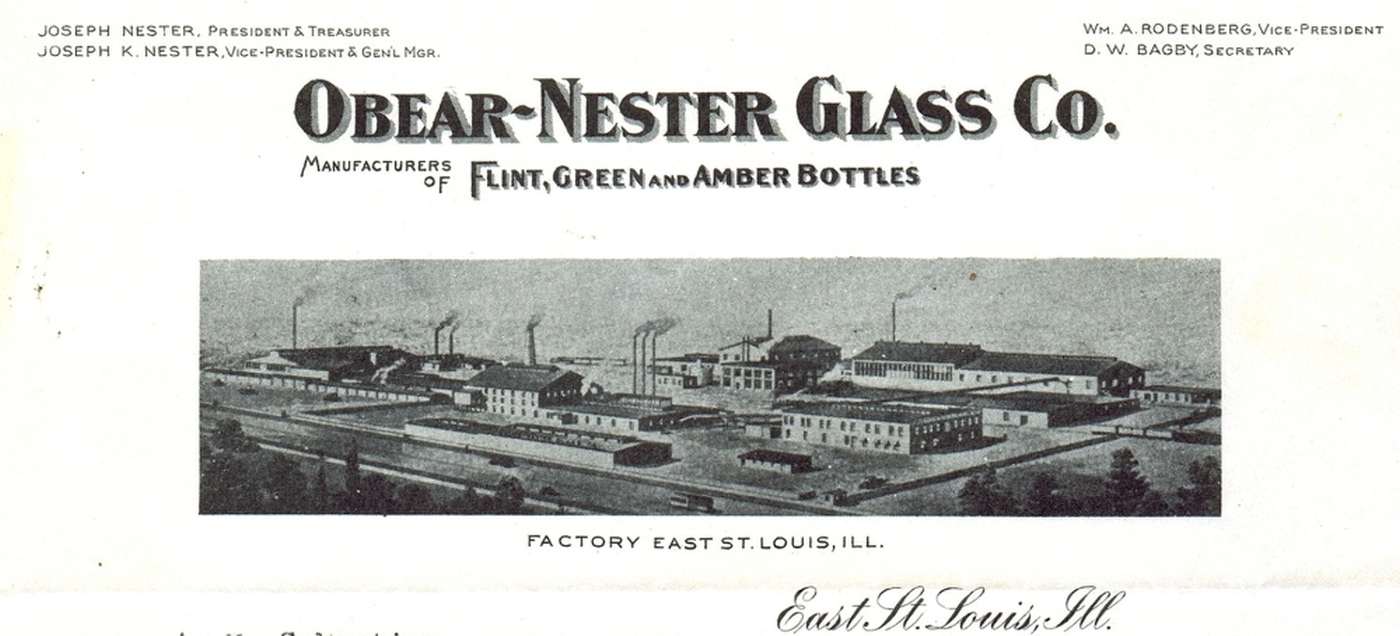
This glass container factory in East Saint Louis, Illinois started out as Allison-Obear Glass Company (1891-1892), later was known as Obear Glass Works (1892-1894), and then after some reorganization it became Obear-Nester Glass Company in 1894.
Obear Nester also operated a bottle factory in Kansas City, Missouri from 1903 to about 1928. They also purchased a glass plant in Lincoln, Illinois in 1952 and ran it until 1978. That plant – formerly known as Lincoln Glass Bottle Company – was renamed “Lincoln Container Corporation” in 1952 and produced bottles marked with an “L inside a square” on the base.
(More detailed information and background history of the Obear-Nester factory, its owners, the glass furnaces at the works, and all the known marks they used can be found in the article by Bill Lockhart et al, referenced farther down on this page).
The “N in a square” trademark was used on machine-made bottles from approximately 1915 up to their glass plant closing in 1978.
Some sources indicate that Obear-Nester Glass Company used an “N in a rectangle” or an “N in a square” mark soon after the company started – circa 1895, but I don’t know of any bottles confirmed with this mark that actually date that far back. If any exist, they would be mouthblown bottles, not machine-made.
Julian Toulouse (Bottle Makers and their Marks, 1971) wrote that the “N in a square” mark dated from 1915 and was used only on machine-made bottles.
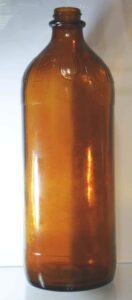
The “N inside a square” is by far the most common mark seen on glass containers made by Obear-Nester Glass Company. The mark is usually located on the bottom of the bottle or jar. It is often seen on amber (“beer bottle brown”) bottles of many types, including chemical, oil, medicine, cleaning products, general household, and beverage bottles.
Fruit jars were made in clear glass in the mid-1970s – they bear the brand name “Longlife” on the front and “OBEAR-NESTER GLASS” on the base. (Some Longlife fruit jars were also made by other factories).

Some amber Orange Crush soda bottles are seen with the “N in a square” mark on the bottom. On beverage bottles, typically the logo is accompanied by a date code, usually two numbers located to the immediate right of the “N”, which would stand for the last 2 digits of the year the bottle was made. (However, on many NON-BEVERAGE bottles of various types, a single digit next to the logo is not a date code, but believed to be a mold number).
ADVERTISEMENT
NOTE: There were at least two other slight mark variations used by Obear-Nester, specifically, N inside a circle, and just a Plain N, which are much less commonly seen. They are listed on Page Four of the Glass Bottle Marks pages.
Obear-Nester also made a line of druggist bottles that were marked “ASEPTIC” on the base. Some of those were “generic” pharmacy bottles, and others were “personalized” slug plate types with the name of the druggist, drugstore or apothecary embossed on the front of the bottle. Obear-Nester also produced druggist bottles marked “REX” and “BANNER” on the bases.
FACTORY LOCATION The Obear-Nester Glass Company factory complex was located on a large rectangular area of ground situated between 19th and 21st streets in East St. Louis, bounded on the east by E. Broadway and on the west by the Southern Railway (now Norfolk Southern Railroad) . (Judging from modern Google Earth photos and maps, what used to be 21st street is now the location of a railroad).
From information gleaned from early Sanborn Fire Insurance maps, in 1905 the extensive factory grounds included four large separate glass factories (buildings) numbered “Factory #1” through “Factory #4”, plus many smaller outbuildings – apparently a total of at least 20 buildings existed at that time.
An overhead view on Google Earth appears to show there are few if any buildings left – the view (I am uncertain on the exact date of that photo) seems to show two smokestacks still standing among the “footprints” of old buildings long gone and scattered trees and vegetation.
NOTE: Researchers looking for background information on Obear-Nester may encounter several YouTube videos – posted within the last few years – purporting to show the old abandoned Obear-Nester glass factory buildings. In reality, those videos are mistakenly showing an entirely unrelated factory complex about 6 blocks to the northwest of the actual Obear-Nester Glass Co. site – the video tours show the graffiti-covered walls and rusted steel staircase inside what used to be the A. Schumler Inc. “Rubber Salvage & General Storage” business. That was a tire reclamation or “tire splitter” operation that salvaged rubber tires and fabricated useful items from the rubber -such as gaskets, shims, automotive tailpipe insulators, doormats, etc. (Some of this info from “Solid Waste Management in the Fabricated Rubber Industry, 1968, an EPA publication) . That abandoned factory is located just north of 14th Street between McCaslane Ave. and Walnut. A search of Sanborn Fire Insurance maps from 1950 prove that the factory in those videos is not Obear-Nester, and in fact the buildings were erected in 1917, many years after Obear-Nester was already in business. (I do not know when that rubber reclamation factory was shut down).
Note: Special thanks to SandyR1951 (Ancestry.com member) who states that the Obear-Nester Glass Company plant shut down permanently on December 31, 1978. This info was posted on that site, in response to a query I had posted there back in 2004. After nearly 9 years, I am correcting my information here!!
For much more detailed information about Obear-Nester Glass Company, check out this article from researcher Bill Lockhart and the Bottle Research Group:
Obear Nester Glass Company – SHA.org
For an extensive list of glass manufacturers’ marks on bottles, fruit jars, insulators, tableware and other glass items, please check out the GLASS BOTTLE MARKS pages, here starting on page one.
Please click here to go to my site Home Page.
ADVERTISEMENT
I have a bottle, I think it’s a 5 gallon water, blue green color and the logo is plain letter N. WHAT YEAR BELONG THIS BOTTLE?
Hi Earnel, can you please check your Facebook “Other” folder next to your Messages INBOX. Can you send a pic of the bottle (or bottles) to davidrussell59 “at” att “dot” net ?
Thanks, David
I found a brown jar with the “N in a square”. It is 9 1/2″ tall, wide-mouth, with big dimpled bands across the top and bottom… It still had a steel lid screwed on.
Hi Kristin, I think you have a COFFEEMATE Carnation Coffee Creamer jar, or a similar product such as OVALTINE. Best regards, David
We are finding the slag glass in woods near Missouri Avenue, East St. Louis. Does anyone know the address of the glass factory? Large pieces of brown clear, and bluegreen.
Hi Kathy,
It may be a dumpsite used by the glass factory……not sure. I am not familiar with the exact location in East St. Louis but I’m sure someone who is familiar with the history of the area, and has further details, will land on this site sooner or later and let you know. If you have access to older city directories or phone directories (1978 and older), the information on exact address should be easily found. Please let me know! Best regards, David
Obear Nester was located at 20th & Broadway.
David, thanks very much for that information!!
~David
You’re welcome. My father worked at Obear Nester for 37 years, right up until it closed. I don’t believe they ever dumped glass off-site. A certain percentage of cullet was added to each batch. Cullet was valuable to the company. Thanks. David Walker
Thanks for the info, David (Walker)! Perhaps Kathy Wright can respond to this…….. looking at a satellite map, it appears the area southwest of Missouri Avenue (generally between 20th and 21nd streets, and northeast of Broadway) could be a likely spot where slag glass was found, since (I assume) that is close to where the factory stood.
Also……it does seem that some glass companies dumped more of their “waste glass” than others. For instance, it is known that large amounts of broken glass was dumped, both near the factory and at an off-site dump, by the Hemingray Glass Company of Muncie, IN, although this did occur over a very long period of time so the actual amount (percentage-wise) wasted may have been very small (during any given day, or week).
Best regards,
David
To David Walker, my mother Annie Colter worked there till it closed. I have pics from there at that time. I am Bob Colter.
My great grandfather came here from Sweden where he was an established glass blower. Arrived 1904. Family has pieces of art he blew by mouth. Amazing. Want to learn more about Obear Nester, any thoughts? Our relatives probably knew each other.
Hi Tamara,
Obear-Nester Glass Company made mostly “utilitarian” type glassware such as typical bottles and jars for commercial use – including soda, beer, whiskey, chemical bottles, medicine containers, canning jars, etc.
They were in business in East Saint Louis, IL from 1894 to 1978, and made huge quantities of bottles over that time period. The most common mark seen on bottles made by Obear-Nester is their “N inside a square” trademark, usually seen embossed on the bottom – and the mark is seen on later machine-made bottles after about 1915.
Some “offhand” or “whimsy” glass pieces, such as canes, hats or “frogs” and other small art pieces, were likely blown by individual workmen at the factory after their regular work shift was over. This was a common occurrence at most earlier glass factories of the late 1800s and early 1900s – when the glass was blown entirely by hand – before the introduction of bottle-making machines.
The workers were permitted to do this when small amounts of molten glass was left over from regular bottle production, and to show their skill in glassblowing.
Such items were not a regular part of the factory’s glass production (containers to be sold commercially) and such pieces were usually taken home as gifts to friends or family members. Assuming your grandfather worked at Obear-Nester and other bottle-making factories this could well have been where he made some of those items you mentioned.
I’m sorry but I don’t have any specific information on the many glass workers that were employed at Obear-Nester over the years. This article (.pdf file) also has a lot of background information about Obear-Nester relating to their history, dates of operation, bottle production and marks used: Obear Nester Glass Company – SHA.org
Concerning your great grandfather, that is very interesting. So when you wrote “here”, at first I thought you meant the United States in general, but re-reading your post I presume you did mean the Obear-Nester Glass Co. factory in particular. I’m sorry because I wasn’t totally sure what you meant. So I presume you have some family history about his working in East St. Louis. Is the information oral (passed down by mouth, over generations) and/or does it include any written papers?
Have you been able to find information on where he worked at in Sweden before coming to the US? Did he perhaps start up his own art glass studio somewhere here in the United States?
Sweden is well-known for producing a lot of upscale, fancy art glass / decorative glass (by both established glass companies and individual artisans).
In 1904 there were LOTS of glass companies here in the East and Midwest US that produced a variety of glass products including pressed, blown and cut glass tableware; decorative glass; containers of all types including canning jars; electrical insulators; industrial glass such as railroad light lenses and light bulb covers and much more.
Many of those glass firms were located in West Virginia, Pennsylvania (especially Pittsburgh), Indiana, Ohio, and several other states.
There were also other glass companies located in the St. Louis area – the largest and best known was “Illinois Glass Company” in Alton, IL – they used to be the biggest glass bottle producer in Illinois and surrounding area and were in business starting around 1873. That company employed thousands of workers over the years. They merged with the Owens Bottle Company of Toledo in 1929 to form the mega-corporation “Owens-Illinois Glass Company” that is still in business today.
Sorry I don’t have detailed relevant information on Obear-Nester to pass along. Good luck with your further research! You might be able to find more information with searches of old census records or city directories online.
Take care,
~David
(PS. I’m not sure if your reply was directed specifically to David Walker who posted his comments in 2015. He may not see this, as his post was written over ten years ago. I’m David Whitten, the webmaster of the site). 🙂
[Update 8/27/2025 – Tamara, I also sent you direct emails and have not received a reply so it is possible my email messages were diverted to your account spam/junk folder. Unfortunately this is happening more often, especially in the past couple of years, as more email service providers are getting increasingly aggressive with their spam-blocking algorithms, and are flagging legitimate emails as possible spam. Thanks! ].
If anybody could tell me the year on this bottle because i cant find the same letters and numbers to match up i found pictures that look like this bottle but different letters its a brown Anheuser short bottle with 4 anheuser eagle with A logos going around the top and it says please don’t litter above that then at the side bottem going around it says not to be refilled with number 17 after no deposit ☆no return. On the bottom of bottle on to has letters BN-1000, then middle left has the letter N in a square, then middle right it has 17x and at the bottom center has the number 71 does that mean its anheuser beer in a nester glass company made in October 17,1971??
Hi Sara,
From your description, your bottle was definitely made by Obear-Nester Glass Company, and I also think the “71” is a date code for 1971. Many beer bottles of the early 1970s had the “PLEASE DON’T LITTER” phrase (or some similar phrase) on them. The “17X” is probably a mold number, and BN-1000 the bottle design/inventory/stock number. As far as I know, no ordinary commercial bottle molds were ever engraved with markings to indicate a specific date a bottle was made (such as October 17, 1971) as that would have been costly, extremely impractical and unnecessary. The engraving was done on the inside of a metal bottle mold, and the mold was then used for months or years. When molten glass is blown into a hollow bottle mold, the molten glass moves against the inside and fills in the engravings which results in the embossing (raised lettering) you see on the glass surface.
I hope this helps,
David
I have an amber glass bottle about 9 inches tall with an N in a square and with the number “4” on the right of it. It also has wings in glass on the top. There is one on e-bay if you put “old amber glass bottle with wings” in the description. What came in this bottle?
Hello Joanne! That bottle is a typical “generic” shape, usually called a “chemical” bottle by glass manufacturers, and the type was normally used to hold such products as bleach, hydrogen peroxide, ammonia, and other liquid cleaners and chemical products of the same genre. The thing unusual about that bottle, as you note, is the ‘wings’ on the closure (I might call them “lugs”, “tabs”, “prongs” or “projections’ but I’m not sure what the exact term is which was used at the time). Evidently that closure type was quite short-lived as I haven’t seen them before on a chemical bottle, although on some other types of bottles I’ve seen lugs which are shorter and less pronounced. I’m guessing that the bottle dates from the 1930s or 1940s (possibly 1950s?) but I can’t narrow it down better than that!
~David
We found a bottle with 2 glass post coming out of the neck of the bottle. It’s about a 16 Oz brown glass bottle. It has the N in a square and an 8 about an inch away.
I found a clear rectangle shaped bottle about 2″ tall X 1/2 ” wide, flat, squared off corners, screw top lid-intact- N in square on bottom and number 2 off to the right. Located in mining country in Arizona
I found a quart (marked 4 cup) longlife widemouth jar with fruit and vegs design in a circle on one side and the words OBEAR-NESTER GLASS on the bottom. Can you give me more info.
I have a clear glass bottle. Bottom says Miller High Life, under that the N inside the square and a #2 above the Miller. The middle of the bottle says no deposit, no return, not to be refilled. Trying to find out a year it was made. Thanks
Amy, if there is no date code on the bottle, I can’t say exactly when it was made. However, just making a guess, it sounds like a bottle from the 1970s. “No deposit, No return” was a very popular phrase marked on bottles during that time period, although similar wording is still used to this day.
David
The #2 is probably a mold number. It would be extremely difficult to add a date code to the bottles Obear Nester made. I am not aware of any of the ware (bottles) being date coded.
Hi David (and Amy),
It may be true that most typical utilitarian Obear-Nester bottles and jars don’t carry date codes, but many of their soda bottles do. The date code, at least on the examples I’ve seen, follows the same placement on the base as used by some other glass companies such as Owens-Illinois, Glenshaw, Anchor Hocking, and Brockway on their sodas. That is, the date code consists of two digits (the last two digits of the year) and is located immediately to the right of the logo (usually) placed in the center. This may not be seen on all Obear-Nester soda bottles, but it is surely seen on a lot of them. Here are two examples I found online, one showing a 1978 bottle, and another is an ebay listing showing an Obear-Nester soda bottle with a 1949 date code [2nd link below deleted 3/23/2021 – item URL no longer valid].
It seems that most date codes were used on earlier soda bottles to help shed light on the “average use life” of returnable bottles. The heavier-walled returnable-type bottles were often used dozens or even hundreds of times before getting so worn that they could not be safely used. The practice of date coding has continued even into the era of “Non-returnable” soda bottles.
Pepsi bottle found at an abandoned old farmstead in Eudora, Kansas – oldglassbottles.blogspot.com
Hope this helps,
David
I found a bottle buried with some old brick on our property. It’s a large, gallon-size, amber jug. There is an n in a square on the bottom with the number five just below it. There is a seam on each side of the bottle leading to a textured top of the body with a one-inch horizontal line halfway up on each side of the textured top. The spout has a finger handle and a screw-top mouth. There are no other markers to indicate what this bottle was for or when it was made? Any ideas?
Obear Nester made gobs of amber jugs and bottles of many types. I think the jug you found would be a “generic” type, one of many slightly different styles (made by many glass companies) used for such products as bleach, ammonia, hydrogen peroxide, or other liquid chemicals/cleaning products. Some are used for edible liquids such as apple cider or vinegar. Try doing some ebay searches with keywords such as (jug,bottle,jar) (vinegar,apple cider,bleach,chlorine,coke syrup) (amber,brown) in the search box, and see if you can find similar examples.
Best regards, David
I found a bottle with code R-424, 72 n 40. I assume the n is Obear Nester and the 40 is 1940. What are the other codes?
Tom, I’m not familiar with the code system used by Obear-Nester. The “40” might be a code date for 1940 but I can’t guarantee that is correct. The “R-424” could be an inventory number assigned to that bottle style, or perhaps (if that is a liquor bottle) it could be a “rectifier number”.
~David
If I may interject. The R# is a rectifier’s permit code – found on liquor bottles. The other codes are: 72 = Obear-Nester’s permit # to make liquor bottles (after Prohibition was lifted) and the 40 IS the date code for 1940. 🙂
Thanks a lot, Carol! I appreciate any help I can get here.
Take care,
David
I just found one that has Federal Law prohibits sale or reuse and the marks on the bottom are : D-201. 72 N (It’s in a square) 7
It is a dark brown possibly half pint liquor bottle. Any idea of a possible date or if it’s even made by this manufacturer?
Thanks in advance!
Hi Nancy, sounds like the “72” is a date code for 1972. Typically, most bottles with the “Federal Law…..” phrase date before 1964, but there are some that were made as late as the 1970s and even more recent than that. Yes, I am sure it is a product of Obear-Nester. No other glass bottle company in the United States used the “N in a square” as their trademark.
~David
[Reply update/edit – March 23, 2021 : Nancy, I was re-reading some of these posts and I realized I was wrong about the “72” on that bottle. The “72” is actually a “Liquor bottle permit number” assigned to Obear-Nester Glass Company, and the “7” is the date code. I don’t know what year the 7 represents, but probably 1947, 1957 or 1967.]
Carol is correct. Below is the source showing the 72 is their permit code. My bottle has the 72 above D-23 7, and 54 below. The 72 is their permit code, and I believe the 54 is the year of manufacturing. I believe the D-23 7 may be a distillery code. Still researching that, but if you could confirm, I would appreciate it.
Liquor Bottle Permit Numbers list – Sha.org
I have a similar bottle, square “N” which almost all sites agree are Obear Nester. 72 is the permit number for the manufacture to produce bottles that will contain liquor. Mine has “49” on the lower right which is the year the bottle was made. R424 was much harder, but is the permit number of the distillery. R424 is Southern Comfort! I am including links below that I hope work for future treasure hunters.
List of codes including Rectifier numbers, Distiller numbers, etc. – database compiled by Eric Burke –
Liquor Industry Hearings Before a Subcommittee – December 1943 – Google Books
Hi Andrew,
Thanks for the links! I hope this helps those trying to find out more info. Your post landed in my “spam” folder, (probably because of the extended links) but luckily I noticed it before it could be deleted.
Take care!
David
I found a bottle in perfect condition with the square N and the number 7 on one side and 100 on the other
Hello, I have found a round clear bottle. It appears to have a screw top but the cap is missing. It has seams on the sides of the bottle. It’s 7 inches tall. Has an N inside of a square and the number 4 to the right of it. Any ideas??????
Bill, Obear-Nester Glass Company made thousands of different bottles over many years, and many of them are typical, common, “generic” bottles of which there is little information available. The “4” would be a mold number, but little else can be said for sure.
Best regards, David
I have a small brown bottle (jug) with a screw on top. On the bottom of the bottle is a N in a Square with the number 18. The lower part of the bottle has a white (beige) paint that is easily removable. What can you tell me about this bottle.
Brenda, it is some type of liquor or wine bottle, but I’m not sure exactly what it contained. I have seen those before, and I believe they were issued in the late 1960s or early to mid-1970s. Sorry I don’t have better info for you.
David
It’s a whiskey bottle. I just found one at our local Salvation Army, and it still had some whiskey inside! So unless someone refilled it (always a possibility), then whiskey would be my guess.
I have an old amber Purex bottle that has this mark on the bottom. When were these common?
Hi Cole, I don’t have info on the exact years the PUREX glass bottles were made, but I would estimate most of them date from the 1930s-1960s time period.
~David
Hi David, I’m currently working at an archaeological site in NM and we found a large deposit of bottles that we’re trying to date. Currently they’re ranging from the 30’s-early 50’s. One such bottle is embossed on the bottom with the word wine, then beneath that the N logo in a square and a 9 to it’s right. Beneath those two symbols is a 7, which we are assuming is the mold number (?). Since the 9 isn’t a two digit number, should we assume the bottle lacks a marker for the date, or is this an example of early bottle manufacturers using single digit numbers for dating before moving to double digit?
B.R., I’m not sure, since I am not familiar with all the date coding practices of Obear-Nester. I have seen a number of their soda bottles which usually have a two-digit date code to the right of their logo (similar to the way this was done by some other glass companies) but I do not know about numbers on their wine bottles. Perhaps someone has more info on this, or another researcher has more advanced information than I currently have on this site . Readers?
David
I’ve got a liquor bottle that has the N on the bottom. It also has what seems to be a knight on a horse with the letter C on the side. The bottle itself is a clear 1 quart bottle with a narrow neck.
I have a brown bottle with the letter N in the square. Above the N is the letter L. Below the N are the letters RTC UY PAT OFF. The number 10 is opposite of the N. All on the bottom of this bottle. On the top of the bottom round ledge it says no deposit*no return. Not to be refilled. Any info would be of help.
I have several amber “stubbie” beer bottles that have the Anheuser Busch logo embossed in them. All have the “N” in the square markings. They are from the 60’s and 70’s. For definitive dates, all bottles have a number such as 71, 78, 73, 75 on the bottom, so I will go with that. Would you agree??
Hi David,
Yes, I would agree that the numbers you mention are date codes. Although sometimes a number such as this might be misinterpreted, in the case of many, if not most, bottles produced by some of the major glass bottle companies in the ’60s and ’70s, it can be easy to find the date code. Many beer, soda and other beverage bottles as well as an array of food and other types of bottles were marked with a two-digit number such as 70, 71, 72, etc on the bottom along with other markings. Most of the amber “stubbies” of that time period were so marked. In most cases (not all), the date code is placed to the right of the glassmaker mark, and/or appears in the “3 O’clock” position on the base.
If anyone finds a casual bottle dumpsite from the early 1970s time period, it is usually possible to look for the date codes on a variety of bottles (if all in the same area) and get a fairly good idea of when they were discarded, usually within a year or two of when they were made.
Hope this helps,
David
Helps a lot. Thank you.
I found a bottle that is clear with the N in a square at the bottom. It also has what looks like maullr (could be wrong on spelling) molded in the bottom in cursive and just below the neck is 4 (one on each side) molded in LM marks with the M sitting inside the L.
I have this one too. I thought the r was a z. I just found it.
I have this same bottle I found it in the old part of Lake Lewisville years ago during an extreme drought I’m not sure what the bottle is but what you describe is exactly like what I have if you know anything about it let me know thank you
Thanks Suzan,
[Readers, Suzan sent me a photo of the bottle – the lettering on the bottom does look like “Maullr” but she realized it was actually “Maull’s” which is a brand of steak sauce. She also sent a google image search results page]. So to John (who made the original query about the bottle back in May of 2019) here is a listing on Worthpoint of an older Maull’s bottle:
Vintage 1926? St Louis Missouri- Maull’s BBQ Sauce Bottle – Worthpoint.com
(Actually that bottle appears to be from the 1950s or 1960s, not 1926, but there is a good base photo of the bottle there).
Evidently the Maull’s bottles were made by more than one glass company over the years. The brand seems to be still in business, available currently in plastic bottles.
~David
John, It’s been five years since you posted your comment and I hope you will see this, but please check out my answer to Suzan’s post, below. Thank
you!
~David
What about N inside a square with a 6 to far right
Andrew, the “6” is a mold number and doesn’t give us any useful information.
David
I found a Listerine Lambert Pharmacal Company round 4 and 1/4 clear bottle with a cork at the beach, in WA state. It has a N with a rectangle and a 3 with an underscore. I realize it may be a Obear Nester bottle, but is there any way to know what the year might be? Lorrie
Lorrie, I am not familiar with the date coding system(s) used by Obear-Nester over the years, although on some bottles there are two-digit numbers placed to the right of the logo which are surely date codes. In your particular case, the “3” is merely a mold number which doesn’t help us with dating the bottle.
Best regards,
David
I was having a furnace guy putting a new one in, and in a crawl space where ducts are, he found three wine bottles. One is brown, tall, has N in a square by Obear Glass company. It has 4/5 quart embossed on it as well as grape vines. Bottom does have 2 numbers, looks like a 6 and a 9, also wine is embossed on the bottom. The other 2 are clear and have 1 pint embossed on them as well as wine. They too have grape Vines. The numbers on the bottom are, 424 on one the other has looks like 6 and 7
They all have seams. The brown one has a bottom that looks like it was put on separately.
My house was built in 1900.
Thank you,
Melissa Hurd
Hi Melissa,
Thanks for your post. I can only say that since the brown (called “amber” by bottle makers) bottle has the “N in a square” mark, we know it was made by Obear-Nester Glass Company. I can’t say who made the others if there aren’t any glassmaker marks on them. The numbers such as “424” are probably catalog numbers identifying the style or shape of bottle. I would guess they date from the 1930s-1950s time period, but it is hard to assign a specific date to the bottles, since Obear-Nester made many bottles over a very long period of time.
David
Found a Mogen David wine bottle, clear glass with a honeycomb pattern on the sides, with the “N in a square” in the middle of the bottom. It also has “Design Patent No 158213”, and when you look up that design patent, it was filed in 1949 and issued in 1950. So that homes in on the actual date in more detail than just the maker’s mark. So, that makes it 1950 to 1978.
Hi, I’m from Trinidad and Tobago, I found a brown bottle today with the boxed N and 5 on bottom of bottle, it also has 2 pieces on top where the cap goes, maybe to tie I guess, interested in knowing its age?
I found a clear glass full pint glass bottle marked D-130, 72 N(in a square) 6 on the bottom. It has the Federal Law Forbids statement near the top on one side & an embossed Atlas figure holding the world near the top on the other side (not sure which side is the front). I know it was produced by Obear-Nestor probably mid 1930’s, & that D-130 is the Distiller Permit Number, but would like to find out which liquor company this logo belongs to. Thank you.
Hi Mary Ann,
I am guessing you have one of the “Wilson” whiskey bottles? I don’t know anything about them but here is a listing from the Worthpoint site, showing one of the bottles with an original label still attached (link below). I presume it was a brand sold in the 1930s, and was probably rather short lived.
Vintage Wilson “That’s All” Clear Glass Whiskey Bottles
Best regards,
David
Thanks for your quick reply, but I’m pretty sure it’s not a Wilson Whiskey bottle. I had already found the link you gave & the bottle shape is completely different, there is no “Wilson” or “That’s All” anywhere on the bottle, & the Atlas logo is small & only near the top on one side of the bottle. I can send photos, but not sure how to do that. Thanks again.
Hi Mary Ann,
Thanks for your follow-up reply. [Readers, she sent me photos by email, and it is a flask I haven’t seen before]. I assume it was a bottle design used for only a short time, perhaps for a short-lived brand name. The “6” date code on the base indicates it was made in 1936, and the “72” is a liquor bottle permit number for Obear-Nester Glass Company. Unfortunately I have found no information on that particular flask.
Many, many different flask designs were made (by many glass manufacturers) throughout the early and mid twentieth century. A lot of them were made in relatively small numbers and are now rarely seen. The great majority of those types of bottles were thrown in the trash after the liquor was consumed.
If any of you readers know what company used the “Atlas holding up the world” design on that flask, please chime in!
Thanks!! David
I found the exact same bottle she’s describing today at my local river. Have you heard any word on what this Atlas logo may be between now and when Mary Ann originally posted her question?
Hi Mat,
No, I haven’t received any more comments or info of any kind concerning that bottle. For reference, I found a similar bottle listed on the Worthpoint site. Here is a link pointing to that listing that includes several pictures of the flask. This may give readers a better idea of what is being discussed.
“Atlas Holding the World” Embossed Whiskey Flask – Worthpoint.com
Best regards,
David
Hopefully someone can help me out. I have a bottle with the N in a square 72 on the bottom left and 55 on the bottom right with D 23 8 besides the N, has Rye in gold letters any idea what brand of rye?
Hi Richard,
The “72” is a liquor bottle permit number that was assigned to Obear-Nester Glass Company. The “55” is the date code that indicates the bottle was made in 1955. “D 23” is a distiller identification code number assigned to Hiram Walker & Sons Distillery of Canada. Walker has sold many different products over the years including rye whiskies. Perhaps someone can chime in here and tell you the exact name of the rye whiskey your bottle might have held. Hope this helps,
David
My Dad was a foreman there. He retired in the late 1950s. He had a beautiful bottle collection.