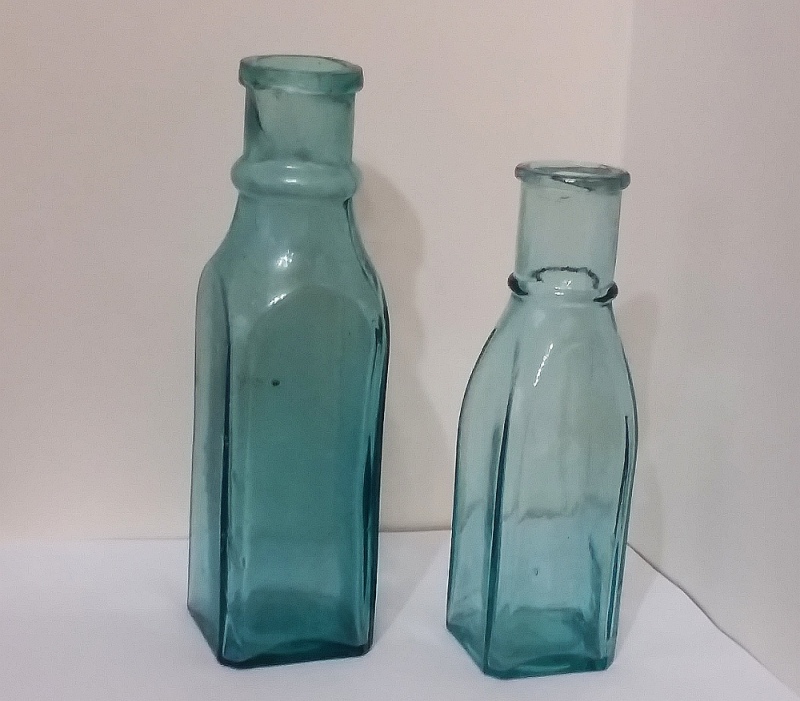
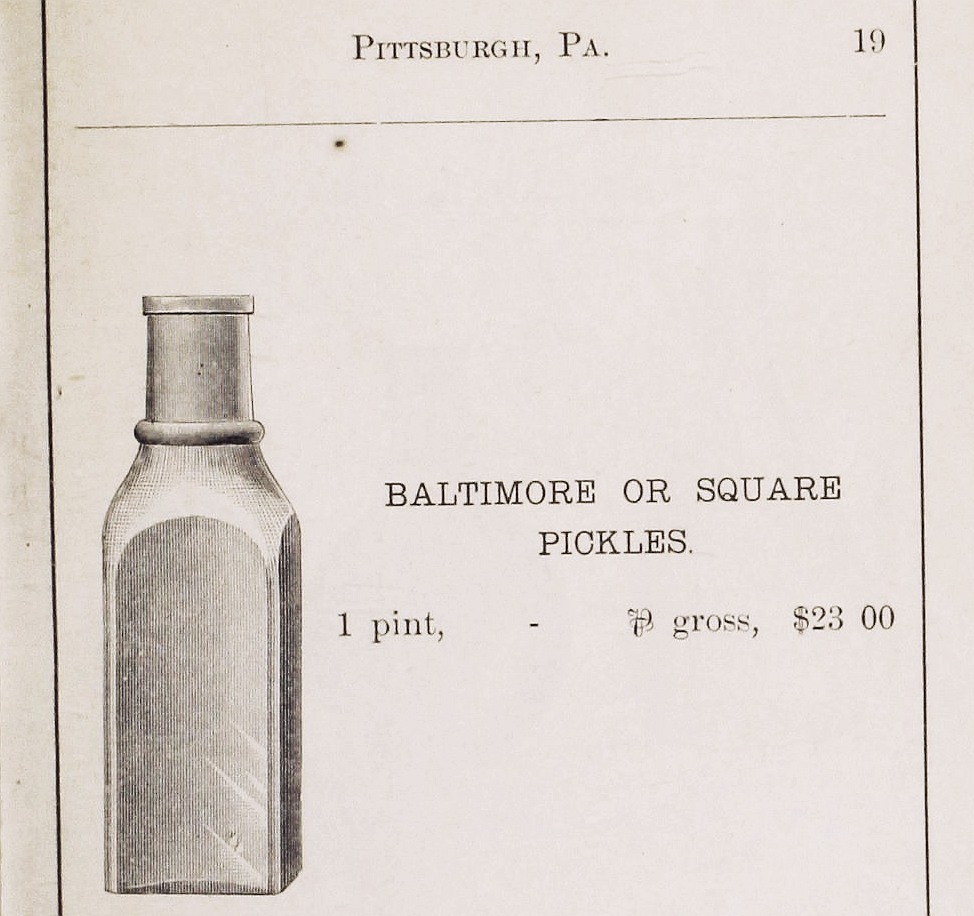
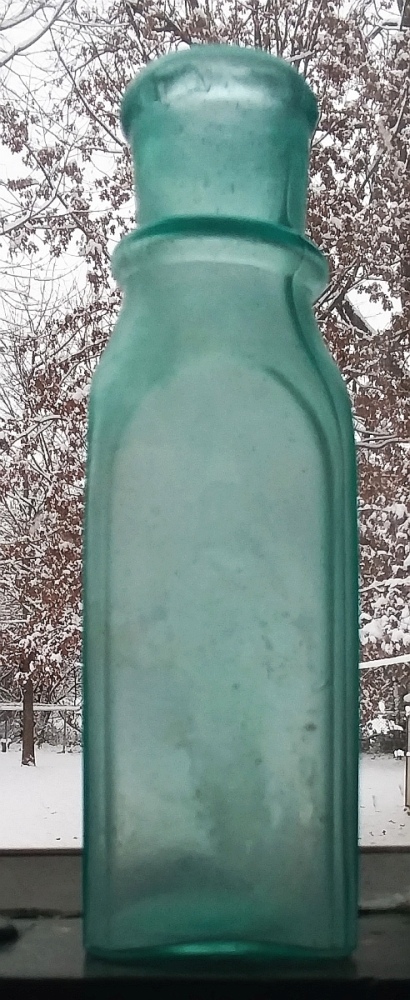
On this webpage I’ve compiled a list of known markings found on handmade (mouth-blown) so-called “American”, “Baltimore” or “Tennessee” style square pickle bottles (pickle jars). Please see photos and catalog pages. The first list below is that of BASE MARKINGS that usually stand for a particular glassmaker. Although many bottle manufacturer’s marks on this list have been identified, several have not.
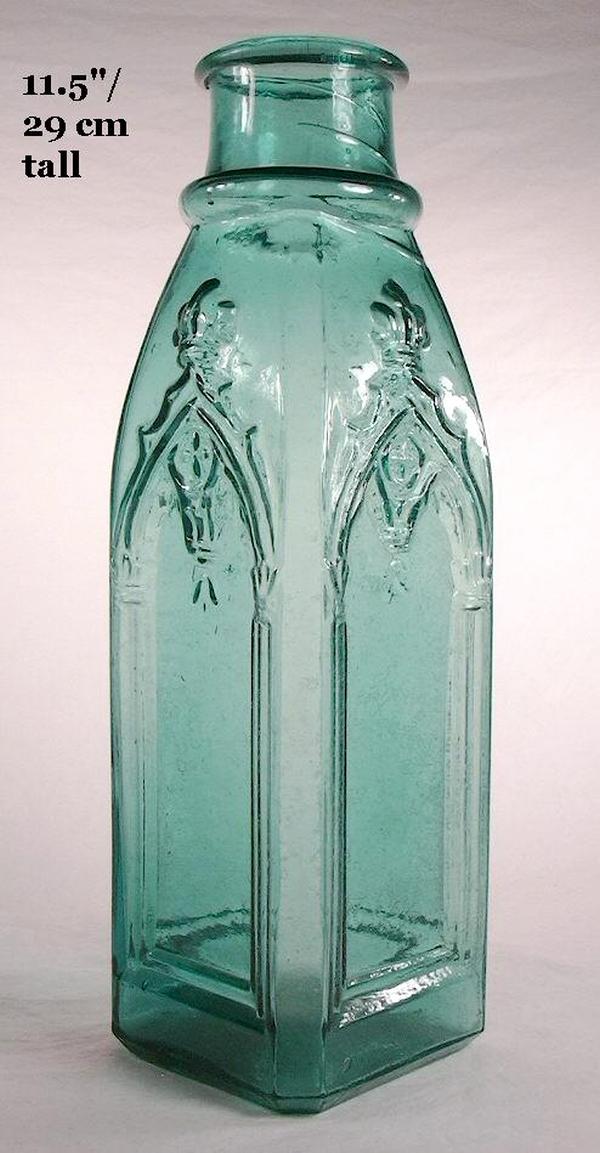
These bottles, for the most part, do not have extra ornamentation that is typical of the older versions of this same style of bottle . They apparently came into use sometime in the 1865-1870 time period, and gradually replaced the much more decorative “Gothic Cathedral Pickle” bottle that had been in popular use since the mid-1840s or before. Evidently, as time went on, especially after the end of the American Civil War, fewer and fewer decorative elements were included – perhaps to save on production costs when cutting the molds, and to speed up production of bottles.
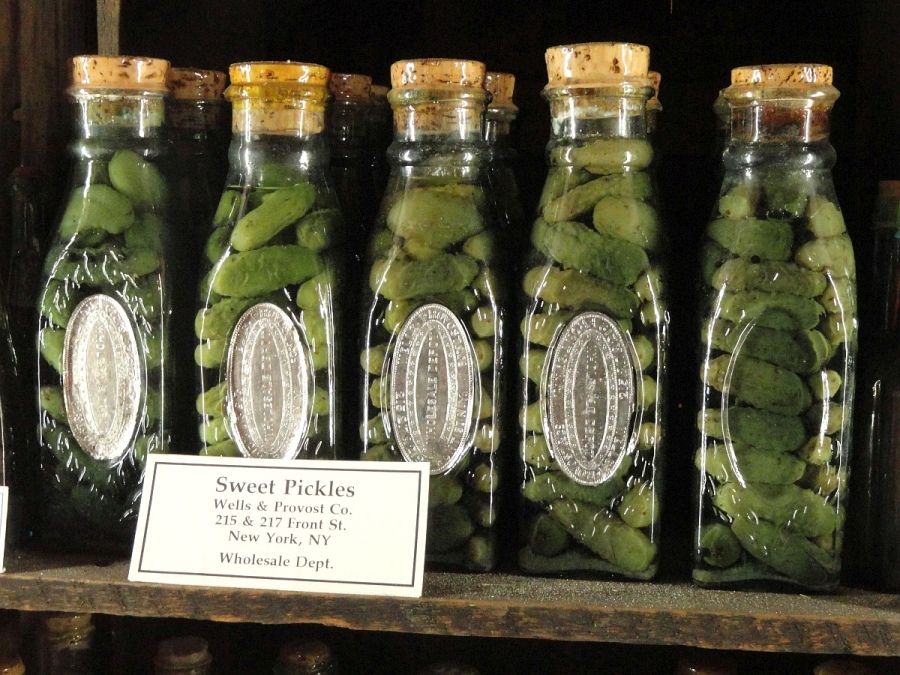
This style of bottle was commonly used for pickles (gherkin pickles, pickled mixed vegetables), occasionally for preserved fruits such as tamarinds, but the general shape was also used for Horseradish.
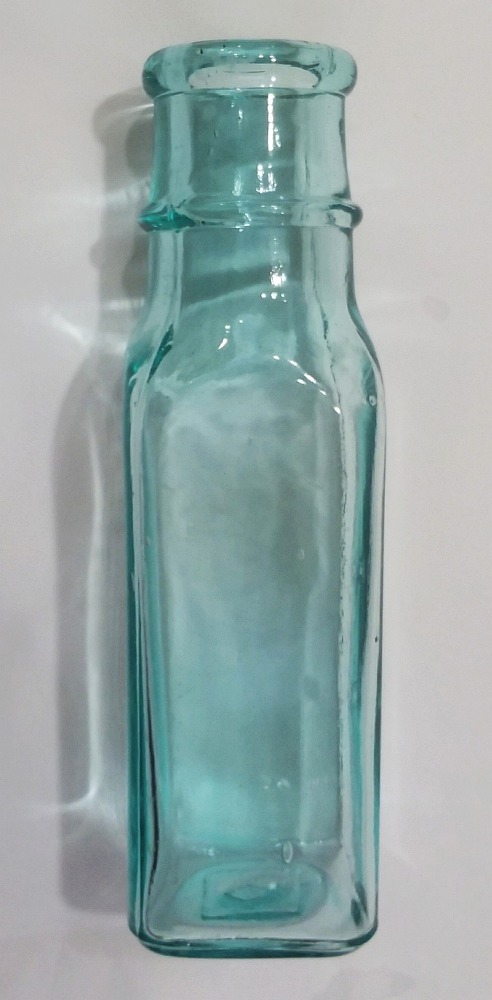
These pickle bottles typically have one raised “ring” or “band” that encircles the neck area just above the shoulder of the bottle. The applied or tooled lip may be either square or rounded (rolled). (In the Illinois Glass Company catalog, the “rounded lip” variant is listed as “Tennessee Style”). All four sides usually have a simplified Gothic arch or panel which is sometimes gently rounded at the top and in some cases somewhat more sharply pointed.
Although these types of bottles were made by hundreds of glass bottle manufacturers in the US, large and small, over many decades, relatively few bear glassmaker marks on the bottom. Probably 90% or more typical square pickle bottles of this type were not marked, so the presence of a mark that can identify the glassmaker/origin gives some extra value to the bottle. Most are seen in shades of aqua (light to medium bluish-green). A few made in citron (bright yellowish green) and in shades of amber are occasionally found by bottle diggers and are very scarce. Some of the more recent bottles, circa 1900s-1920s, may be in clear (colorless) glass, or nearly colorless.
Some bottles of this type were made as late as the 1920s and ’30s, although most of the mouthblown examples date before around 1915. Some of the older bottles tend to show more crudity, with applied lips and various flaws and bubbles in the glass.
HONEY BOTTLES A somewhat similarly styled bottle (although not usually featuring arches on the sides) was also used to contain honey. The honey bottles typically are lettered “1/2 POUND PURE HONEY”; “ONE POUND PURE HONEY” or “TWO POUNDS PURE HONEY” and feature an embossed beehive design on the front. The beehive may be quite ornate, or rather simply drawn. The oldest aqua bottles intentionally made for honey are relatively scarce, but newer types made in clear glass are quite common. Some of the older clear bottles may turn shades of amethyst from long sun exposure. Darker shades of purple may have been irradiated. (Honey bottles are not included in the markings listed on this page – that would make a nice project -outside of the scope of this page – for someone else to tackle!).
The first list below includes pickle bottles I have seen, or have verified by searching eBay, Worthpoint, Etsy and other online listings. If you have information on any other glassmaker base marks you can confirm exist on a bottle of this type, please contact me!
(Note – some more information on the glassmaker marks listed below may be found in the alphabetical marks sections of this website – Page One through Page Five).
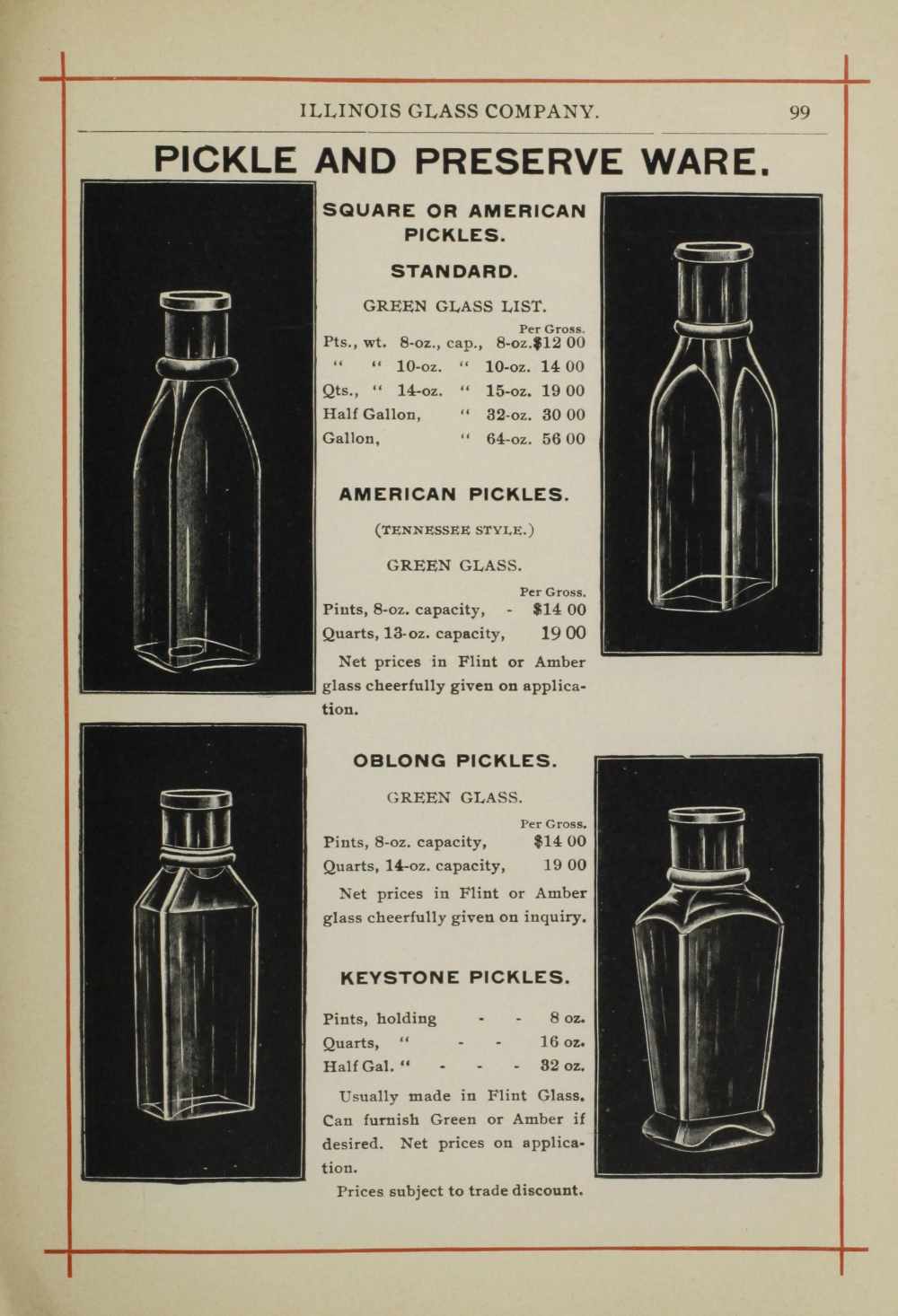
(PART ONE) Most of these bottles are marked only on the base:
1) B inside a diamond (rhombus) ~ Binghamton Glass Company, Binghamton, New York (probably most were sold as Horseradish bottles)
2) B/500 [other mold numbers may be found] ~ Buck Glass Company, Baltimore, Maryland (clear, tooled lip)
3) Belt Buckle (Oval with horizontal line) ~ Western Glass Manufacturing Company, Denver, Colorado
4) CROWN (King’s Crown emblem) ~ Unknown meaning
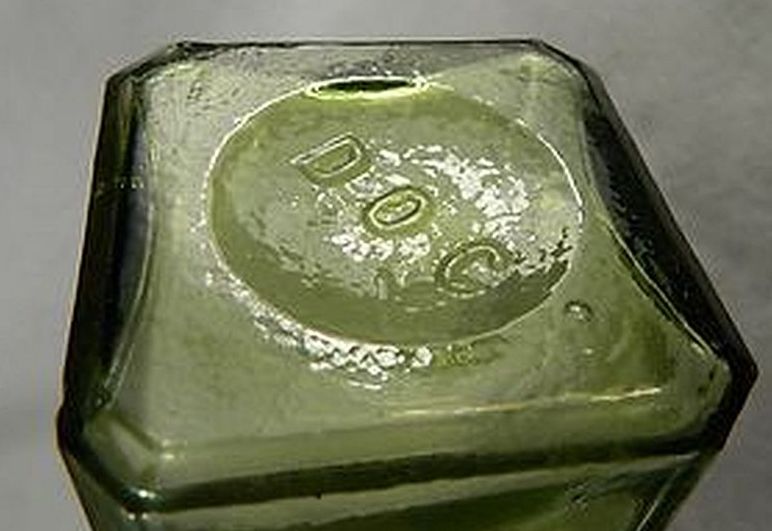
5) D. O. C. ~ Dominic O. Cunningham, Pittsburgh, PA (confirmed on base of citron colored bottle, 7 and 1/4th inches tall)
6) F.C.G.CO. ~ Falls City Glass Company, Louisville, KY (verified on at least three sizes of bottles)
7) H (On lower neck underneath ring – above shoulder) ~ Unknown meaning -smaller bottle (Dave Beeler listing)
8) I.G.CO. ~ Illinois Glass Company, Alton, Illinois
9) I inside a Diamond ~ Illinois Glass Company, Alton, Illinois
10) J. J. G. ~ Unknown meaning – could stand for an obscure bottle factory or perhaps a food packer or distributor?
11) K. G. B. CO. Kearns- Gorsuch Bottle Company, Zanesville, Ohio ( in clear glass; this bottle has rectangular footprint, not square)
12) K.H. & G. Z. O. ~ Kearns, Herdman & Gorsuch, Zanesville, Ohio (On HONEY / BEEHIVE bottle)
13) KY.G.W. ~ Kentucky Glass Works Company, Louisville, KY (relatively simple Gothic Cathedral window arches design, four sided). Only known specimen illustrated in “Ketchup Pickles Sauces” Betty Zumwalt, page 261.
14) L.G.CO. ~ Lindell Glass Company, St. Louis, MO (4-sided bottles as well as a 6-sided Cathedral type is known. A six-sided bottle exists in citron).
15) O (large round ring/circle) ~ Unknown meaning – perhaps a glassmaker mark OR a mold identifier
16) Pacific Glass Works (on base), along with star on shoulder ~ Pacific Glass Works, San Francisco, CA
17) S.B. & G.CO. ~ Streator Bottle & Glass Company, Streator, Illinois (seen with various mold numbers)
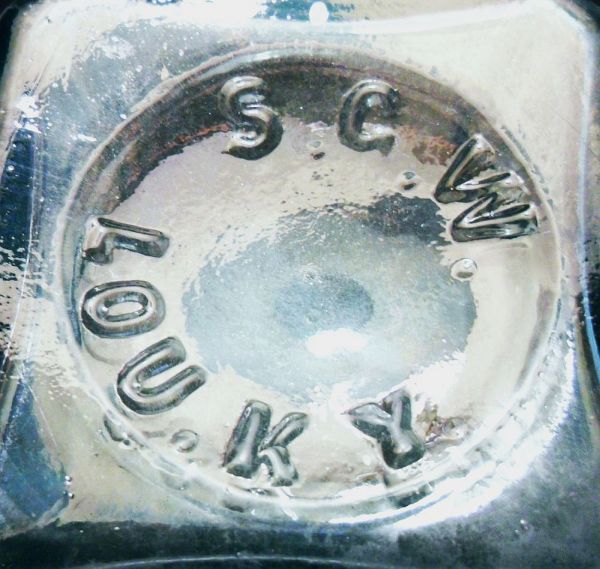
18) S.G.W. LOU. KY. ~ Southern Glass Works, Louisville, KY (seen only on small half-pint size pickle bottle – as below)
19) SOU. G. WS. ~ Southern Glass Works, Louisville, KY (on pint, quart, and half gallon pickle bottles)
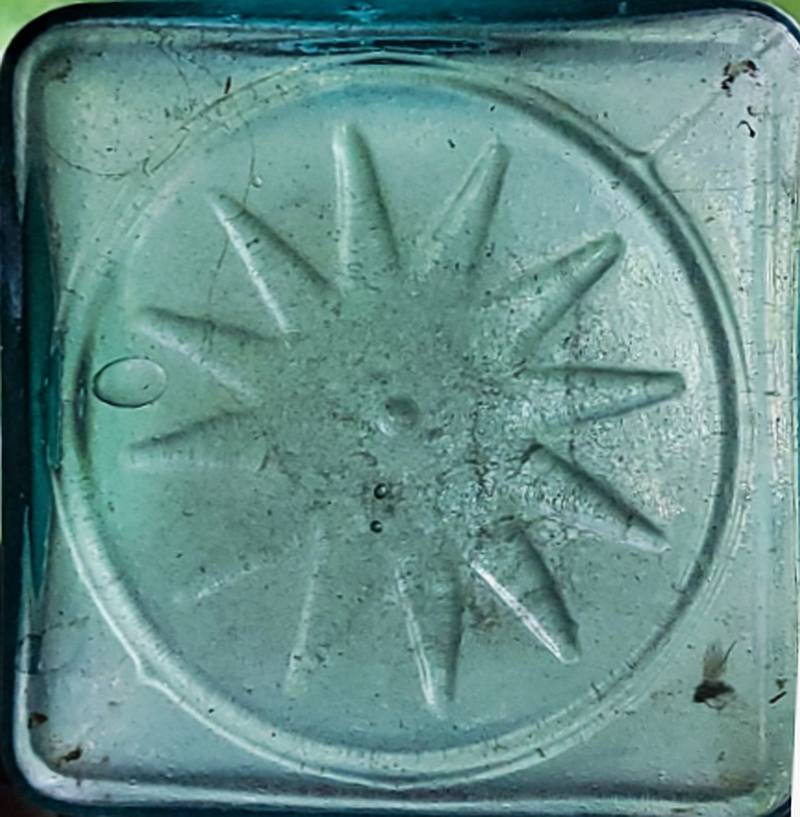
20) Star (12-point asterisk type star on base – the points are “thin” and almost needle-like) ~ Attributed to Pacific Glass Works, San Francisco, CA
21) Star (12-point star, the star resembles a “Sun with 12 triangular rays”). Uncertain maker. (See photo near the bottom of this page).
22) Star (on shoulder) ~ Pacific Glass Works, San Francisco, CA
23) Star on front (very large strongly embossed 5-point star) ~ Unknown meaning
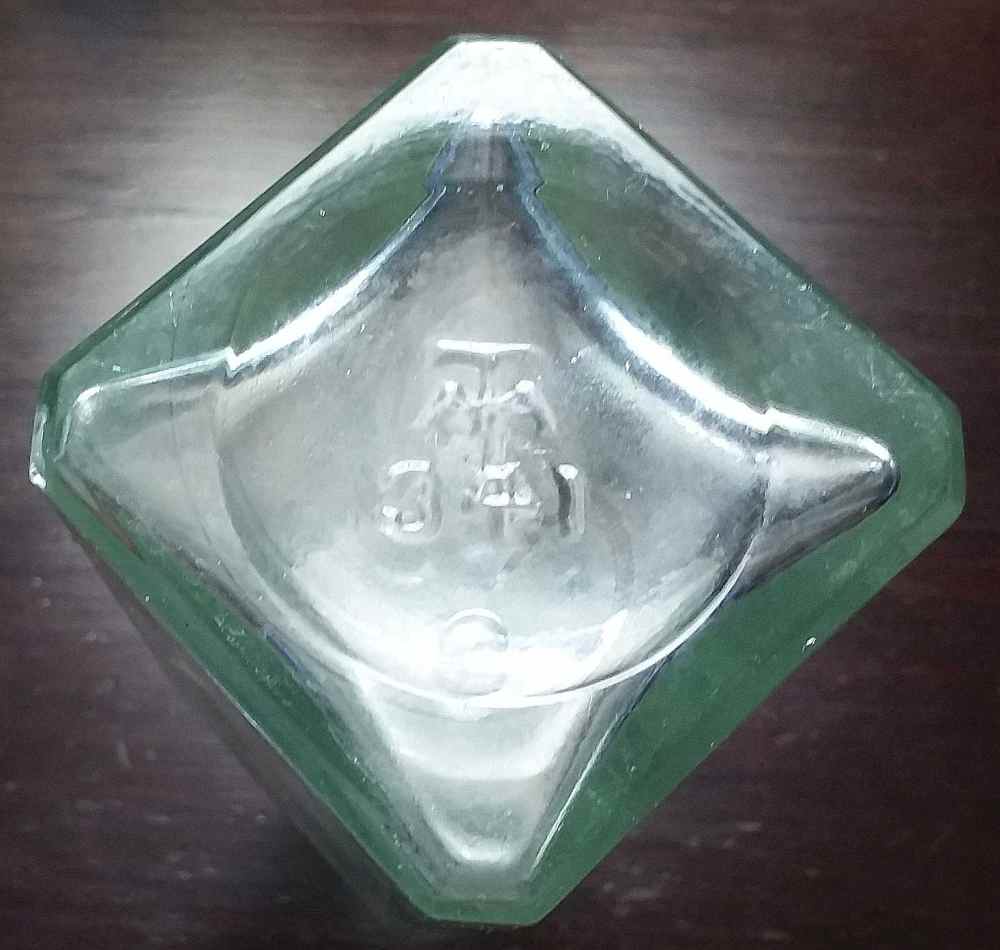
24) T/M monogram ~ Modes-Turner Glass Company, Cicero, Indiana
25) W ~ Unidentified, but possibly made by either Thomas Wightman & Co. or Wormser Glass Company, both of Pittsburgh
26) Whitney Glass Works / Glassboro NJ (in circle on base). ~ (On gallon size six-sided Cathedral bottle)
27) WIS. GLASS CO. MILW ~ Wisconsin Glass Company, Milwaukee, Wisconsin (examples occasionally seen in amber or citron glass).
28) W. T. & CO. ~ Whitall Tatum & Company, Millville, NJ (Seen on square as well as Larger Hexagon type pickle bottles)
29) Large “X” or “+” sign ~ Unknown glass manufacturer – probably a mold identifying mark – several glassmakers may have used a similar mark
30) Raised Dot or Dots ~ Mold identifying mark – difficult if not impossible to identify maker (unless quantities of shards have been found at a particular glass factory site or dumping area).
31) Unmarked on bottom ~ In most cases the glass factory source cannot be identified with certainty.
*************************************************************
(PART TWO)
Some additional confirmed markings that have been seen on the front/sides of square pickle bottles of this general type (most here do not indicate glass companies, but instead food packaging firms or distributors). There are likely many, many other examples in existence from across the United States. But these are bottles I have seen or heard of:
W M & P N.Y. (Wells Miller & Provost, New York, NY) – initials on base, or names spelled out on shoulder.
Globe Pickle Co. St. Louis, MO (7.25 inches tall)
” ” (6 and 7/8ths inches tall)
(several embossing variations on the front/sides of bottle).
C.P.CO. (Cutting Packing Company, San Francisco, CA)
H. J. HEINZ CO. 13 (rectangular footprint, NOT square – this bottle design was patented April 4, 1882, Design # 12,544. Aqua bottles are scarce, clear bottles are common).
Heinz, Noble & Co. Pittsburgh, PA.
Heinz & Noble Pittsburgh, PA.
A. DUX & SON, Newark NJ. (smaller, likely a horseradish bottle)
N. Lindeman Newark, N.J. (horseradish bottle)
PURE HORSE RADISH H.D.GEER THREE RIVERS MASS (7 inches tall, aqua, embossing arranged horizontally on bottle so read correctly when bottle is standing up)
IMPERIAL (on shoulder) 8.75 inches tall, light aqua (on Worthpoint)
ADVERTISEMENT
(PART THREE)
Some known markings on Gothic Cathedral-style pickle bottles – These bottles usually have some kind of ornamental gothic arch device on at least three sides – motifs may include wreaths, leaves, garlands, scrolls, diamonds, triangles, etc. Although MANY design variations of Cathedral gothic pickle bottles are known, the ones listed below include those that have some lettering.
Most (not all, but most) of these bottles are somewhat older (than the examples in the base-marked list at the top of this page), and date from the 1840s into the 1880s.
(Credit: the list below is extracted from the outstanding reference book “Ketchup, Pickles, Sauces – 19th Century Food in Glass” by Betty Zumwalt, 480 pages, published in 1980 by Mark West Publishers).
R & F ATMORE (In arc near top of one side)
ATMORES (lettering is vertical, on two sides)
BAKER & CUTTING / GLASS & PICKLE MFRS. / SAN FRANCISCO
BATTY & CO. TRADE MARK LONDON
J.S. BIRDEN & Co. / HARTFORD, CT.
H. E. COY – ROCHESTER, N.Y.
CR (backward lettering, on base of gothic cathedral bottle). The initials have not been identified with certainty, but probably stood for either Curling, Robertson & Co, or Curling, Ringwalt & Co, both of Pittsburgh, PA. (A number of these bottles were recovered from the steamboat BERTRAND that sank in the Missouri River on April 1, 1865).
S. J. G. (vertically on gothic panel)
LANDSDALE & BRO.
J. M. COLLICK & CO. / NEW YORK
NONPARIEL PICKLE WORKS / JERSEY CITY
PACIFIC VINEGAR & PICKLE WORKS / SAN FRANCISCO CALIF (on base)
T. B. SMITH & CO. / PHILADA. (Vertically lettered on side, at least 3 different sizes)
W. D. S. N.Y.
W. D. SMITH / N.Y.
John Thomas / Yonkers / N.Y. (vertically lettered on side- 6 & 1/2″ tall)
WM. UNDERWOOD & COMPANY / BOSTON / 16 OZ
WILLIAM UNDERWOOD & COMPANY / BOSTON / 64 OZ.
E. H. V. B. N.Y. [for Elias H. Van Benschoten, NYC, in business c.1849-1854]
SOL WANGENHEIM & CO./ SAN FRANCISCO (in circle on front)
WELLS MILLER & PROVOST (around shoulder)
WENDELL & ESPY – PHILA (embossed in arch)
W. T. & CO. (found on 4-sided and 6 sides Cathedral type bottles – marked on base)
Swan in flight (design on shoulder of bottle) ~ Unknown meaning
Large “S” superimposed over 16-point star (on base)
**************************************************************
Listed in “Bottled in Illinois” (Farnsworth & Walthall, 2011) on page 492-493:
J. G. / WESTERFIELD // EVANSTON, ILL. // C. & I PITTS PA (on base)
This page is currently under construction!
Please click here to go to the GLASS BOTTLE MARKS HOME PAGE.
ADVERTISEMENT